Why Math Crossword Puzzles Are One of the Most Effective Ways to Improve Mental Math Skills
It sounds almost too simple to be true. A grid. A pencil. A handful of numbers crossing each other like streets on a map. And yet hidden inside that humble little puzzle is one of the most powerful learning mechanisms cognitive scientists have ever measured — a mechanism so effective that it quietly outperformed a multi-million-dollar “brain training” empire in a head-to-head clinical trial.
Most people think of these puzzles as a way to kill ten minutes. But few realize they’re secretly tapping into the two most proven techniques in all of learning science. And by the end of this, you’ll understand exactly why a paper-and-pencil math crossword can do something that companies spent billions trying — and failing — to sell you.
Today you’ll discover the surprising truth about math crossword puzzles, the science behind why they actually work, and the line between what they genuinely do for your brain and the wild claims that got an entire industry fined by the federal government.
And near the end, we’ll get to the moment a simple crossword went head-to-head against a famous brain-training app in a real medical trial — and the result stunned the researchers who ran it.
Let’s count down.
12. The Puzzle That Isn’t Really a Crossword
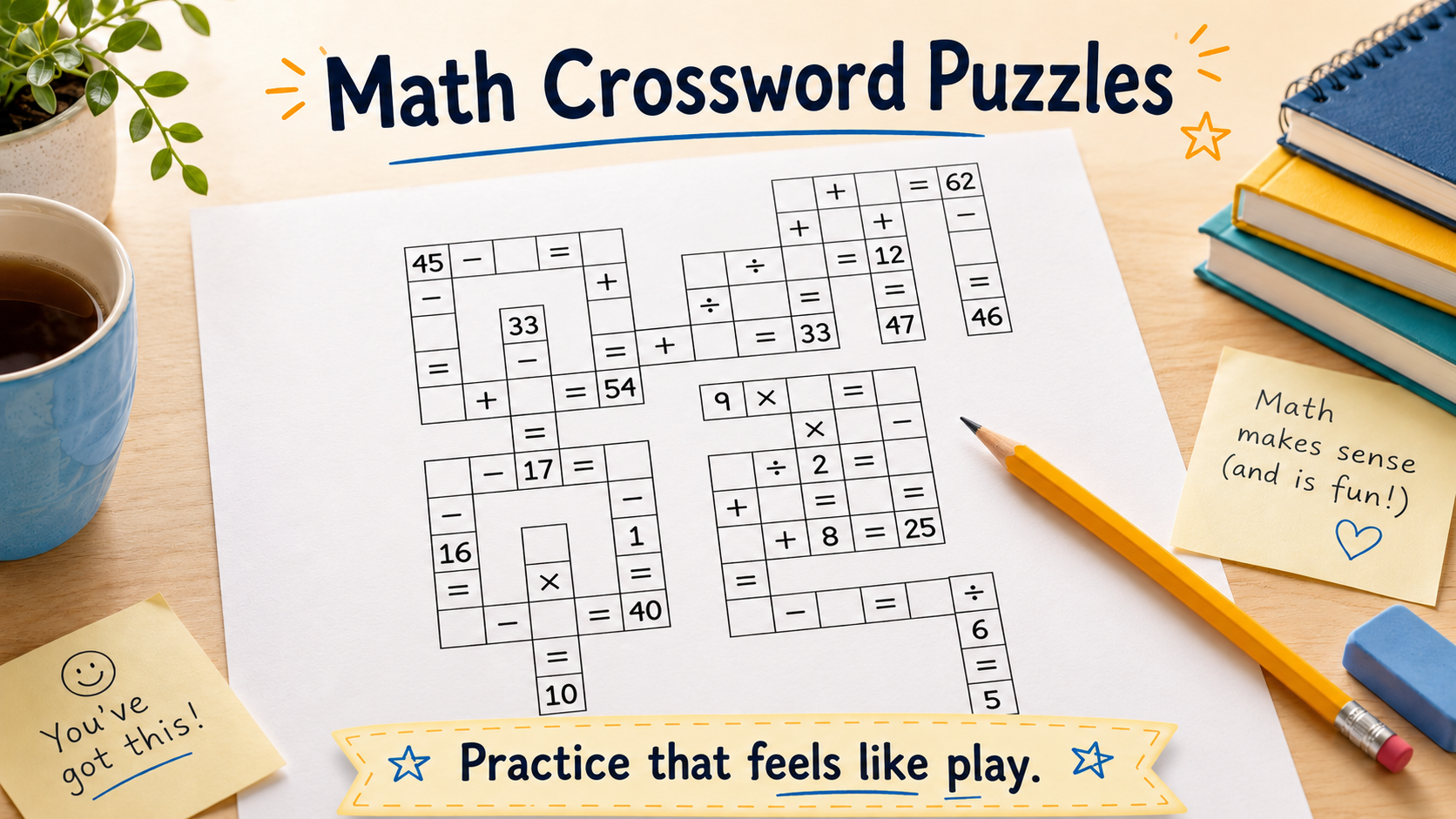
Most people assume a “math crossword” is just a regular crossword with numbers thrown in. But the real thing is its own creature. A cross-figure — also called a cross-number or crossnumber puzzle — is, in the words of its definition, a puzzle similar to a crossword in structure, but with entries made of numbers instead of words.
Here’s the wild part: the style most of us recognize from classrooms, where arithmetic equations with visible plus, minus, multiply, and divide signs lock together in an intersecting grid, didn’t come from a newspaper games desk. It emerged from a serious 1960s math curriculum called Math Workshop, written by Robert Wirtz, Morton Botel, and W. W. Sawyer. These weren’t meant to entertain. They were engineered to teach.
11. The Forgotten Inventor
You might think the crossword’s numeric cousin showed up recently. But few realize it traces back nearly a century, to an English puzzle-maker named Henry Ernest Dudeney, who lived from 1857 to 1930.
Dudeney published what’s widely regarded as the first known crossnumber puzzle in the mid-1920s, appearing in The Strand Magazine, where he ran a column for roughly twenty years. And here’s a detail that humanizes the man behind the math: Dudeney once accused the famous American puzzle-maker Sam Loyd of stealing and republishing his work. According to his own daughter, Dudeney would sit “raging and seething,” equating Loyd with the devil himself. The genteel world of puzzles, it turns out, had its share of bitter rivalries.
10. The Crossword Was Once Called a Sin
Before we go further, here’s a twist that reframes this entire story. When the very first crossword — Arthur Wynne’s “Word-Cross” — debuted in the New York World on December 21, 1913, the establishment didn’t celebrate it. They sneered.
The New York Times in 1924 dismissed crosswords as “a primitive sort of mental exercise” and called the craze a “sinful waste.” The paper held out until 1942 before finally adding one. So the next time someone tells you puzzles are a waste of time, know that you’re standing in a very old argument — and that the skeptics eventually came around.
9. The “It-Makes-You-Smarter Puzzle”
Most people have heard of KenKen, the grid puzzle that blends arithmetic with logic. But few know its original name. Created by a Japanese math teacher named Tetsuya Miyamoto in the early 2000s, KenKen roughly translates to “cleverness-cleverness.” Its first Japanese name translated even more boldly to “the It-Makes-You-Smarter puzzle.”
Miyamoto built his entire teaching philosophy around what he called “The Art of Teaching Without Teaching” — the radical idea that struggling productively through a puzzle teaches more than a lecture ever could. His puzzle series went on to sell over 1.5 million copies in Japan alone, and in 2009, KenKen became the first daily feature The New York Times added since the crossword itself.
8. The Machine That Makes a Million Puzzles
Here’s the wild part about how these puzzles reach you today. The KenKen Classroom program delivers free puzzles and lessons to over one million students every single week, with 25,000 teachers worldwide subscribed. Since 2009, more than 125 million games have been played online.
And almost none of them were made by hand. KenKen puzzles are now generated by an artificial intelligence program nicknamed “The Kenerator.” A 2020 documentary, Miyamoto and the Machine, told the strange story of how one teacher’s handmade puzzles became an industrial operation churned out by software — a small, quiet preview of the automation conversations we’re having everywhere today.
7. The Real Reason They Work
Now for the science — and this is where the story gets serious. In 2013, a landmark review led by cognitive scientist John Dunlosky examined ten popular study techniques to rank how well they actually work. Out of all ten, only two earned the top “high utility” rating: practice testing — also known as retrieval practice — and distributed, or spaced, practice.
Here’s why that matters. A math crossword is, at its core, repeated retrieval practice. You’re not passively rereading a multiplication table; you’re forcing your brain to pull the answer out, again and again. And because puzzles invite a little-bit-every-day habit, they naturally spread that practice across time. In other words, a single math crossword quietly combines the two most evidence-backed learning techniques humans have ever measured. As Dunlosky’s team wrote, these methods “benefit learners of different ages and abilities” across many tasks and real educational settings.
6. The Hidden Engine: Your Working Memory
But why does building arithmetic fluency change anything? The answer lives in your working memory — the mental scratchpad where you juggle information in the moment. Cognitive scientist Helen Abadzi at the University of Texas put it vividly, arguing that people are “basically prisoners to their working memory.”
When basic math facts become automatic, they stop hogging that limited mental space. As researchers studying arithmetic fluency have noted, committing math facts to long-term memory “frees up working memory” for harder thinking. And the gap here is real: one study cited in the research found that only 13% of 155 students assessed had achieved fluency in basic multiplication facts. Most people assume they “just aren’t math people.” But often, they simply never made the facts automatic.
5. The Self-Checking Secret
Here’s a feature that separates a math crossword from a plain worksheet, and it’s easy to miss. In a crossword grid, every number you write intersects another equation. If your answer breaks one of those crossing equations, you instantly know it’s wrong.
That built-in feedback loop turns the puzzle into a private tutor. There’s no answer key to peek at, no teacher to wait for — the structure itself catches your errors and pushes you to correct them. A worksheet lets you fail silently. A crossword won’t let you.
Before we continue — if you’re enjoying this journey into the hidden science of puzzles, take a second to subscribe. It genuinely helps, and there’s a lot more wild territory ahead.
4. The Billion-Dollar Promise
Now the story takes a darker turn. As the science of mental fitness grew, an entire industry rushed in to sell it. The brain-training market — according to the research firm SharpBrains — surpassed $1.3 billion by 2013, climbing from an estimated $210 million in 2005. Companies promised that their games could sharpen your mind, boost your performance, even hold off dementia.
The biggest name was Lumosity, with over 50 games used, by the company’s own claim, by 72 million people across 182 countries. The promise was intoxicating: play our games, and become measurably smarter at life. There was just one problem. The science didn’t actually back it up.
3. The Reckoning That Changed Everything
This is where the dream collided with reality. In 2010, a Nature study led by Adrian Owen tested brain training on 11,430 people. The finding was blunt: people improved at the specific tasks they practiced, but the researchers found “no evidence for transfer effects to untrained tasks, even when those tasks were cognitively closely related.”
Then came the institutions. In October 2014, around 70 scientists, organized through the Stanford Center on Longevity and Berlin’s Max Planck Institute, issued a consensus statement declaring that the literature did not support claims that brain games “improve general cognitive performance in everyday life, or prevent cognitive slowing and brain disease.” And in January 2016, the U.S. Federal Trade Commission brought down the hammer: Lumosity agreed to a $2 million settlement over deceptive advertising. The FTC’s Jessica Rich said the company “preyed on consumers’ fears about age-related cognitive decline,” suggesting their games could stave off dementia, when “Lumosity simply did not have the science to back up its ads.”
Here’s the crucial lesson buried in all this — the one that makes math crosswords trustworthy. Purdue cognitive psychologist Thomas Redick drew the line perfectly: practicing something repeatedly and getting better at it is “pretty indisputable.” What’s never been proven is the leap to raising your IQ or treating disorders. So when you practice mental math through puzzles, you genuinely get better at mental math. That part is real. It’s only the grander promises that fell apart.
2. The Showdown: Crossword vs. The Machine
And now, the moment that started this whole story. In 2022, researchers including Columbia’s D.P. Devanand and Duke’s P. Murali Doraiswamy ran a clinical trial published in NEJM Evidence. They took 107 participants with mild cognitive impairment, average age about 71, and split them into two groups for a 78-week study. One group did computerized crossword puzzles. The other group played computerized brain-training games — from Lumosity, the very company at the center of the controversy.
The crossword group improved on the cognitive scale used in the study. The games group got slightly worse. The puzzles measurably outperformed the famous app, a result Duke’s Doraiswamy called “surprising and important.” Now, the honest caveat: this trial had no group that did nothing at all, so it can’t prove crosswords cure anything, and the researchers themselves called for more studies. But as a head-to-head contest, the humble crossword won.
1. The Truth That Should Change How You Practice
So here’s the payoff — the single most important truth in this entire story. There are two very different claims people make about puzzles, and almost everyone confuses them.
The first claim is that math puzzles make you generally smarter, raise your IQ, or prevent dementia. That claim is contested, oversold, and the reason an industry got fined. But the second claim — that practicing arithmetic puzzles makes you genuinely, measurably better at arithmetic and mental math — sits on some of the most solid ground in all of learning science. It’s powered by retrieval practice and spaced repetition, the two techniques that beat every other study method tested.
That’s the quiet magic of a math crossword. It won’t turn you into a genius overnight. But it will, fact by fact, intersection by intersection, build the kind of fluency that frees your mind to think bigger. No subscription, no app, no billion-dollar marketing budget. Just a grid, a pencil, and the most proven learning mechanism we know.
Which fact surprised you the most — the sinful crossword, the “It-Makes-You-Smarter Puzzle,” or the trial where a pencil beat an app? Leave it in the comments, and let us know how many of these you already knew. If you think we missed something, tell us below — and don’t forget to subscribe and like so we can keep learning together. Stick around for the next one, where we dig into even more hidden science behind the things you thought you understood.