How Daily Puzzle Practice Can Boost Focus, Memory, and Problem-Solving in Kids and Adults
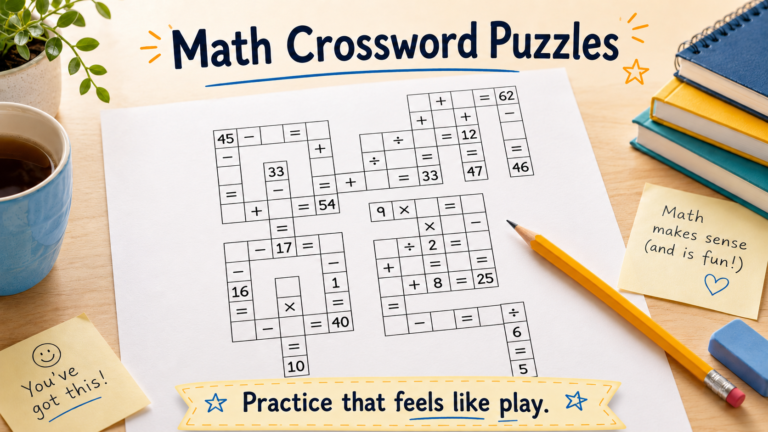
Somewhere in a quiet morning routine — a cup of coffee cooling on the table, a child’s cereal bowl half-empty before school — there’s a small ritual that’s easy to overlook. A pencil. A grid. A few minutes spent untangling numbers that cross each other like little intersections on a map.
It looks like nothing. It looks like a way to pass time before the real day begins. But that humble daily puzzle is doing more than entertaining you. Done consistently, it’s quietly exercising some of the most important mental muscles you have — and the science behind why is more interesting, and more honest, than the brain-training ads ever told you.
This is the real story of what daily puzzle practice can and can’t do for focus, memory, and problem-solving, in both kids and adults. No hype, no miracle claims — just what genuinely holds up, and why a small daily habit might be one of the smartest things you do all day.
The Power Isn’t in the Puzzle — It’s in the “Daily”
Here’s the first truth that reframes everything. The magic word in “daily puzzle practice” isn’t puzzle. It’s daily.
In 2013, a landmark review led by cognitive scientist John Dunlosky examined ten popular learning techniques to rank which ones actually work. Out of all ten, only two earned the highest “high utility” rating. One was retrieval practice — the act of pulling information out of your memory rather than passively rereading it. The other was distributed practice, better known as spacing out your practice over time instead of cramming it all at once.
A daily puzzle habit is, almost by accident, both of those at the same time. Every time you solve, you’re forcing your brain to retrieve facts rather than recognize them. And by doing it a little each day, you’re spacing that practice across time exactly the way the research says you should. Dunlosky’s team noted these methods “benefit learners of different ages and abilities” across many tasks and real educational settings — which is a careful, scientific way of saying they work for kids and adults alike.
So the daily rhythm isn’t just a nice habit. It’s the mechanism. A puzzle done once a month is entertainment. A puzzle done every morning is training.
Focus: The Most Immediate, Most Underrated Benefit
If you want to feel a benefit you can actually notice, focus is where to look first.
A puzzle demands a specific kind of attention. You can’t solve a math crossword while half-watching a screen or replying to a text — the moment your mind wanders, you lose your place in the chain of intersecting equations. This forces a state of single-tasking that’s become genuinely rare in modern life. For a few minutes, your attention narrows to one thing, and you practice the increasingly endangered skill of staying with a problem until it’s solved.
For kids, this is especially valuable. A short daily puzzle is a low-stakes way to practice sitting with a challenge — to build the tolerance for that uncomfortable middle stretch where the answer hasn’t arrived yet but giving up isn’t an option. For adults, it’s a small daily rebellion against a world engineered to fracture your attention into a hundred pieces. Neither of these requires you to believe the puzzle is rewiring your brain. The focus benefit is simpler than that: it’s the practice of paying attention, repeated daily until it gets easier.
Memory: Where We Have to Be Honest
Now we reach the word that deserves the most care, because “boost your memory” is exactly the kind of promise that got an entire industry in trouble.
Here’s what’s genuinely supported. When you practice arithmetic puzzles daily, you build fluency — the ability to retrieve math facts automatically, without effort. This is a real, measurable form of memory improvement, and it matters more than it sounds. As researchers studying arithmetic fluency have noted, committing math facts to long-term memory “frees up working memory” — your mind’s limited scratchpad — for harder thinking. Cognitive scientist Helen Abadzi of the University of Texas put it starkly, arguing that people are “basically prisoners to their working memory.” When your basic facts become automatic, you break a few of those chains.
And the gap here is real. One study cited in the research found that only 13% of 155 students assessed had achieved fluency in basic multiplication facts. Most kids — and plenty of adults — never made those facts automatic, which is why mental math feels so effortful for them. Daily practice is the cure for exactly that.
But here’s where honesty matters. There’s a difference between getting better at remembering math facts and “boosting your memory” in some broad, general sense. The first is well-supported. The second — the idea that puzzles dramatically improve your overall memory, raise your IQ, or hold off cognitive decline — is far more contested. A 2010 Nature study led by Adrian Owen tested brain training on 11,430 people and found that participants improved at the specific tasks they practiced, but there was “no evidence for transfer effects to untrained tasks, even when those tasks were cognitively closely related.”
So when someone promises a puzzle will supercharge your memory, the accurate response is: it will reliably build the specific memory you train, and that specific gain is genuinely worth having. It just won’t turn you into a different person.
Problem-Solving: The Skill Hidden in the Structure
Of the three benefits in our title, problem-solving is the one most baked into the design of a good math crossword — and it’s worth understanding why.
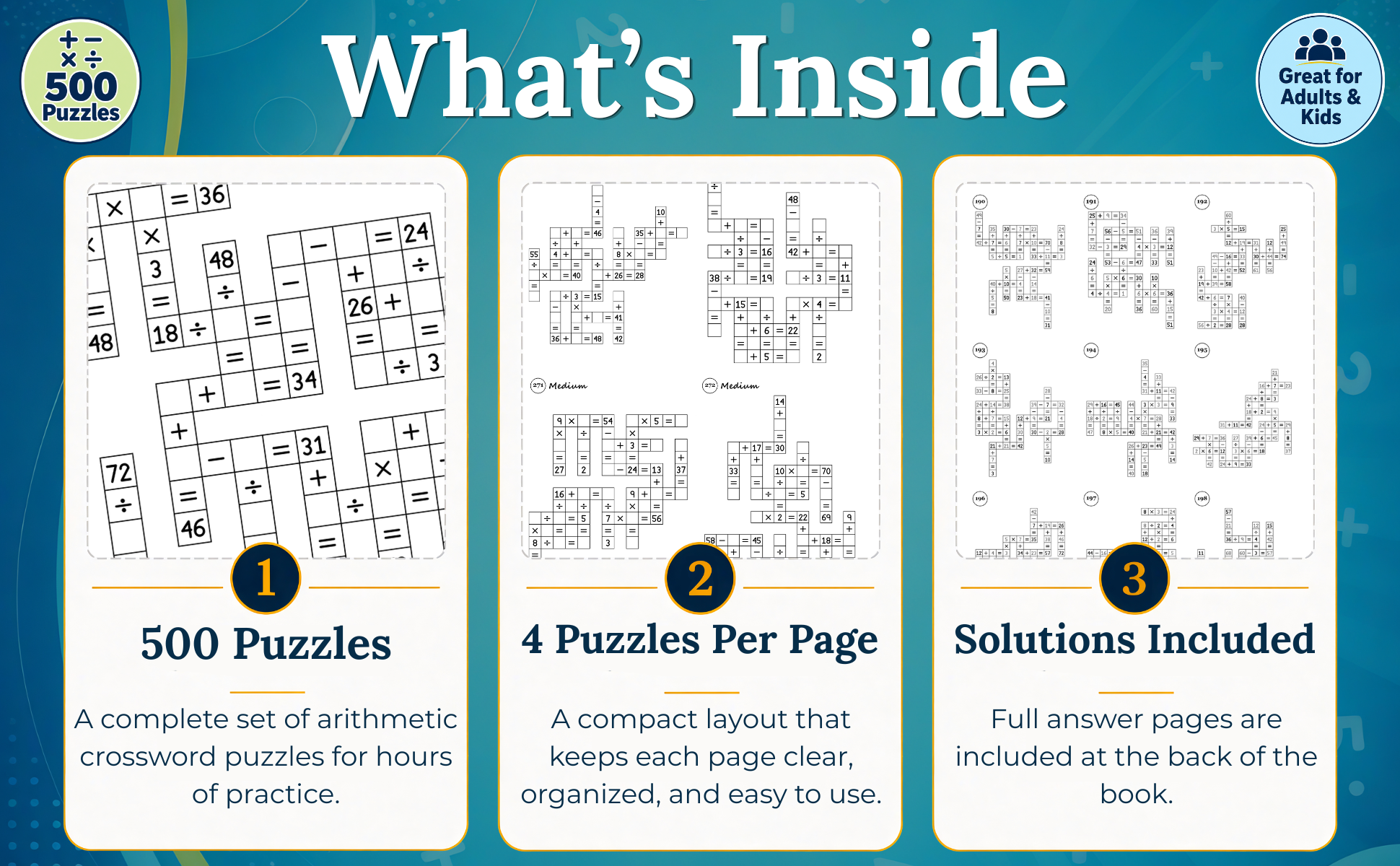
A well-made math crossword reveals very little. Often it gives you only one number per equation, forcing you to derive everything else through the crossing intersections. That single design choice transforms the puzzle from a worksheet into a genuine problem. You can’t just compute your way straight through; you have to reason. You use one equation to unlock a partial answer, which unlocks another, which unlocks another, until the whole grid opens up.
This is the same kind of reasoning that builds the puzzle’s most underrated feature: it checks itself. Because every number you write crosses another equation, a wrong answer doesn’t sit there quietly — it breaks something downstream and tells you you’ve made a mistake. There’s no answer key to peek at and no teacher to wait for. The structure becomes a private tutor, training you to test your own thinking, catch your own errors, and trust the logic to guide you. For a child, learning that your own reasoning can be checked and corrected without an adult stepping in is a quietly powerful lesson. For an adult, it’s a refreshing reminder that careful thinking has a satisfying payoff.
This is also the spirit behind one of the most famous educational puzzles in the world. The math teacher Tetsuya Miyamoto, who created the puzzle KenKen in the early 2000s, built his teaching around a philosophy he called “The Art of Teaching Without Teaching” — the radical idea that struggling productively through a puzzle teaches more than any lecture. A daily math crossword is that philosophy in your own hands.
The Right Way to Think About “Improvement”
If there’s one principle that ties all of this together, it’s understanding what kind of improvement to actually expect — because the people who keep the habit are the ones with honest expectations.
Purdue cognitive psychologist Thomas Redick drew the line about as clearly as anyone. Practicing something repeatedly and getting better at that thing, he said, is “pretty indisputable.” What’s never been proven is the leap to raising your IQ or treating disorders. So practice mental math daily, and you will get genuinely better at mental math. You’ll retrieve facts faster, hold more in your head, and reason through number problems with more confidence. That’s the real, reliable prize.
What you shouldn’t expect is for that to magically transform unrelated skills. The industry that overpromised exactly this paid for it: in 2016, the U.S. Federal Trade Commission reached a $2 million settlement with the brain-training company Lumosity over deceptive advertising. The FTC’s Jessica Rich said the company “preyed on consumers’ fears about age-related cognitive decline,” suggesting their games could stave off memory loss and dementia, when “Lumosity simply did not have the science to back up its ads.”
That cautionary tale is actually good news for the honest puzzle-lover. It means you can stop chasing miracles and enjoy the real, modest, genuinely valuable thing in front of you: a daily habit that sharpens your focus, builds true arithmetic fluency, and trains you to reason carefully — for both you and your kids.
A Habit Worth Keeping
Strip away the hype, and what’s left is genuinely lovely. A few minutes a day with a pencil and a grid won’t reinvent your brain. But it will, fact by fact and intersection by intersection, do three real things: it will train your attention to stay on one task, it will build the kind of fluency that frees your mind for bigger thinking, and it will teach you — and your children — that a hard problem is something you can patiently take apart.
No subscription. No miracle claims. Just one of the most evidence-backed learning rhythms we know, sitting quietly next to your morning coffee, waiting for you to pick up the pencil.